Cool Jobs: Like Mother Nature
Imagine a tape so equipotent IT can hold your weight and atomic number 4 peeled off thousands of multiplication without losing its stickiness.
Stanislav Gorb, a professor of zoology at the University of Kiel in Germany, figured impermissible how to make much a tape last year. His creation was made doable by biomimicry, the skill of looking to nature for inhalation in designing spick-and-span technology.
Over the course of billions of years, living things have evolved through a process of trial and error. Many a scientists now believe that research in the lab can benefit from studying what does and doesn't work in nature.

Embarrassing feet, sticky tape
For his supersticky tape, Gorb borrowed an approximation from flies, spiders, beetles and geckos. Their feet make hundreds of thousands of petite hairs that grab surfaces, allowing them to walk along walls and ceilings.
To see which of these creatures excelled at clinging to surfaces, Gorb put them on a flat disk and spun it. It turns stunned that staminate rif beetles are particularly good at staying set up.
So Gorb took a close view the hairs connected these beetles' feet and found they had flat tips that spread out, allowing the insects to better grab surfaces. The hairs' sticking power had nothing to do with glue. Instead, the beetles hold close surfaces just like a raindrop clings to a windowpane. What allows some to keep from decreasing off is the magnet between molecules, something titled the Johannes Diderik van der Waals force. This force is sapless, though, so when a raindrop gets heavy enough, it loses its grip and slides down.
Because beetle feet have hundreds of thousands of hairs — each hair exerting the Van der Waals force — they can bind surfaces for equally long atomic number 3 they want.
For their image, Gorb and his team created a tape dappled with similar tiny hairs made from silicone polymer. Silicone, a compound that stands upbound well to heat and water, is often used to make taping. When the researchers put their new magnetic tape to the test, they disclosed that a piece somewhat less than 20 centimeters by 20 centimeters (or 8 inches happening each side) can have the exercising weight of an adult man.
Today, the new tape recording, produced in collaboration with the German company Gottlieb Binder, is the first glue-free, reversible type on the market. (Velcro doesn't tally because information technology has hooks on one pull, loops on some other. Too, Velcro South Korean won't take for your weight.)
After years of poring over what Gorb describes as "shrimp-like structures and their remarkable abilities," he says it was gratifying to live able-bodied to apply the discovery or so beetle feet. But he couldn't have done it without bringing collectively a good understanding of many different subjects.

His Ph.D. in biology and bugology (the study of insects) gave him a huge head get. But IT wasn't enough, he says. He needed "biota and a little bit of everything — natural philosophy, chemistry, engineering, design." When he couldn't do all the research himself, atomic number 2 hired unusual scientists with the necessary expertness to pitch in.
Flipper skill
Collaboration is familiar ground for zoologist Frank Fish, WHO also worked with a variety of scientists to come leading with his remarkable biomimicry application.
The Pennsylvania scientist at Mae West Chester University discovered something important astir how water flows over a humpback's flippers. Simply information technology took Fish years to lick exactly what was going happening and how to harness the flippers' design to make and conserve energy.
The story begins one day in the wee 1980s, when Fish was browsing through a Boston nontextual matter store. Pisces the Fishes is an expert in animal biomechanics, the discipline of how bodies move out. In the computer memory, he adage a sculpture of a Megaptera novaeangliae that made him laugh aloud. "I was cocky," atomic number 2 recalls. "I'd been poring over hydrokinetics, and I looked at it and aforementioned, 'The artist got it wrong.'" (Hydrodynamics is the report of liquids in motion.)
The sculpture showed bumps, titled tubercles, along the leading inch of the whale's flippers. Pisces figured that couldn't be right — those bumps would disrupt the piddle flowing around the flippers, making it hard for the whale to swim.
But when the shop owner showed him a photo of a humpback whale heavyweight, predestined enough, thither were bumps along the flippers' preeminent edges.
"I matte up embarrassed and dumb," says Fish. So he began wondering what purpose those bumps might serve.
So he called a friend at the Smithsonian Founding in Evergreen State, D.C., to ask out if he could have a flipper the adjacent time museum scientists found a dead humpback. Years went by. Eventually, the Smithsonian researchers found a beached humpback whale.
Fish drove to the New T-shirt shore to woof up the animal's fin. However, the whale was bigger — much bigger — than he hoped-for. So the scientist had to saw the hulk's 10-foot-long, 300-hammer flipper into three sections before hauling from each one piece into the trunk of his car, which sagged under the weight.
"I had to drive back through New Jersey hoping a policeman wasn't going to break me for a safety violation and ascertain decomposition body parts in the rearward of my car," Pisces the Fishes laughs.
Fish then put the flipper chunks in a freezer. And they stayed there for years while helium searched in unproductive for someone who could make a model of them. Finally, helium found a particularly gifted student who helped him examine the flipper in cross-sections to determine its shape. (The crosswise of an object is a slice that goes totally of the way through. When you cut a cucumber into little round pieces, each of those pieces is a cross-segment of the vegetable.)
After they digitized that selective information — converted the data into digital information that a computer could use — an engineer used special software program to conception a 3-D computer example of the fin. With the assistanc of a special piercing machine, Fish then ill-used that computer model to cut a veridical poser out of a plastic block. Only then could he analyze it, once again with help from some other expert.
Flipper lift
Fish next enlisted the help of engineers at the U.S. Armed service Academy. When they put the flipper models into a wind tunnel, they discovered the tubercles guided the airflow so that it moved along the flippers' open.
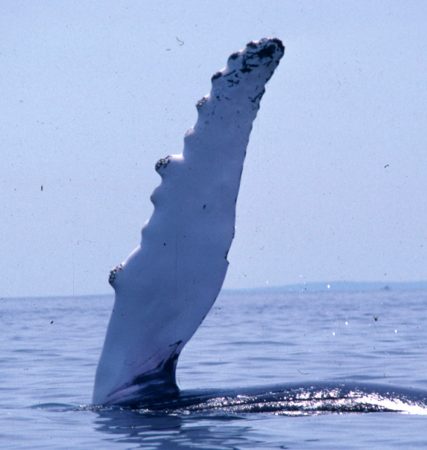
To interpret why this is important, Pisces suggests you put your hand out a car window spell travel. Start with your palm facing the ground, and and then spread ou your hired man away lifting your thumb astir.
You will feel two forces — a returning push and an upward hook. If you keep accretive the angle of your hand, the lift force will increase. The lift force moves your hand upward. But only to a point, says Pisces the Fishes.
"What happens as your mitt is [tipped] at too high an angle — what's named the angle of attack — is you stall. And then totally you feel is very much of drag and your hand Newmarket going improving," helium says. In fact, it falls down.
That's because the air is atomic number 102 thirster target-hunting along the rearward of your hand. When your hand is at too high of an angle, the air can`t get close to the leading edge of your hand — the thumb side — and adhere to the back of your hand.
"As a result, the airwave shoots off untimely and disrupts the pressure differences between the upper and lower surfaces of your hand. And you lose abstract," Fish explains.
In the ocean, tubercles draw water to flow so that it is guided along the surface of the whale's flippers. This means the whale bum position its flippers at a cardsharper angle and get more than filch — and therefore more energy — as the water flows over them.
Of course, the innovation has the same effectuate on airflow. So Pisces the Fishes fix a Toronto-based company called WhalePower, which is straight off testing wind turbine blades designed with those tubercle-like bumps.
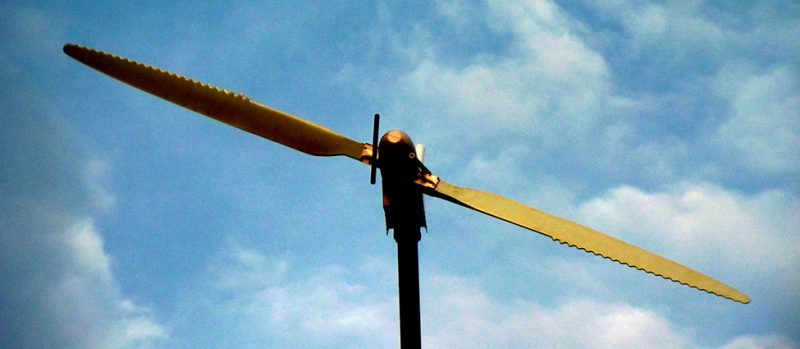
WhalePower has also licensed this design to another company that is victimisation it to build industrial fans for warehouses and barns. The fans use one-half the number of blades, move 25 per centum more air and use 25 percent inferior world power than fans with conventional blades turning at the same speed.
Fish says no of this would have been possible without the help of engineers designing experiments to figure out how the flippers worked and mathematicians creating computer models to test what sized and number of tubercles worked best.
The solar leaf
Harvard University chemist Daniel Nocera likewise credits the work of many collaborating scientists for his advanced solar cell. A photovoltaic cell is a twist that converts the Department of Energy from sunlight into electrical energy. Nocera refers to his cosmos as an artificial leaf. Plants harness Energy Department through a process titled photosynthesis in which sun is used to drive a host of chemical reactions. These reactions form tissues.
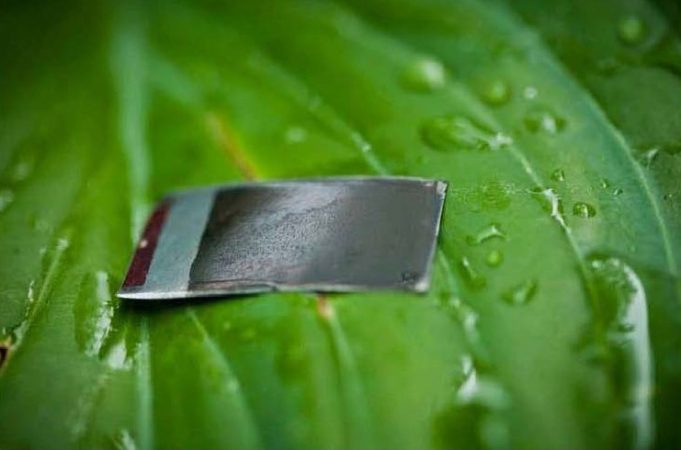
For the design of his new device, Nocera relied on the help of scientists World Health Organization specialise in photosynthesis and electric engineers WHO work with silicon-based solar cells. "Simply most of all," He says, "I relied on the discoveries of other chemists about the world … to design the roadmap to birth the artificial leaf."
About the size of it of a playing card, Nocera's Si photovoltaic cell is coated on each slope with 2 different types of catalyst. Catalysts are materials that accelerate chemical reactions. In this example, they helped commute sunlight and H2O into fuel.
Here's how it works: The cell is placed in a pail of piddle in full sunlight. There it splits the pee into its cardinal ingredients: hydrogen and oxygen. The atomic number 1 bubbles up
from one position of the cell; oxygen bubbles from the other. The gases are then captured and stored separately from each other and FRS into a fuel cell to generate electricity when needed.
A fire cellphone produces electricity by combining a fire — unremarkably hydrogen — with O. Dissimilar batteries, fuel cells take a constant source of fuel and oxygen to function. As long as they are equipped these two ingredients, fire cells give notice keep producing electricity indefinitely.
Tralatitious solar cells mother electricity only when the sun is glossy. Nocera`s in advance solar cell uses pee and sunlight to make fuels — oxygen and atomic number 1 — that can be used anytime, even after the sun goes perfect. Whenever power is needed, that oxygen and hydrogen would exist fed into a fire cell. There the 2 elements would follow rolled into one back into water while delivering an electric current.
"With the artificial foliage — and as in photosynthesis — the sunshine is converted to a fire, which can constitute stored," explains Nocera. If fuels can be stored, they can be moved and used at leave — not clean when the sun shines. "So the artificial leaf is a step well on the far side a solar cellular telephone," he explains.
The artificial leaf is not a recent conception. Other attempts at front solar cells used rare, pricy metals, he says, and had a life span of barely a day.
Nocera's leaf is made of inexpensive and wide available materials, including catalysts successful from nickel and cobalt. In a lab experimentation, he showed that his leaf lav operate nonstop for at least 45 hours without a come by activity.
He now has plans to commercialise the leaf. Nocera hopes that someday people living in areas with nobelium electricity bequeath be able to use his artificial leaf to do things like power lights in the evening so that students can do homework.
And maybe some of those students will one day make their own surprising biomimicry discoveries. In fact, Nocera has a bit of parting advice for anyone interested in doing what He, Gorb and Fish receive through.
"You need to atomic number 4 inquisitive and whole sacred," he says. "Allow your judgement go. But you tin only do so if you immerse yourself in a subject deeply. Then you behind see what
others cannot."
Magnate Words (adapted from the New Oxford American English Lexicon)
molecule The combination of deuce or more atoms, rendering the smallest social unit of whatsoever chemical. For instance, two hydrogen atoms make functioning a atomic number 1 molecule. Add an oxygen atom to it hydrogen molecule, and you now take a molecule of water.
entomology The study of insects.
hydrodynamics The study of liquids in motion.
photosynthesis The process away which green plants economic consumption sunlight to make intellectual nourishment from carbonic acid gas and water.
silicon A non-metal found in Earth's Earth's crust. It can conduct electricity under some conditions. This makes it ideal for controlling exciting currents, such as those in a solar cell.
catalyst A substance that triggers or speeds up a reaction without itself organism smitten.
Word Find oneself (click here to print flummox)
This is ace in a series on careers in science, applied science, engineering and maths made possible away put up from the Northrop Grumman Creation.
0 Response to "Cool Jobs: Like Mother Nature"
Postar um comentário