Southwest International Ethnic Culture and Art Center Art Studio
Culture Blitz
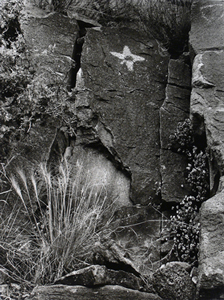 The history of art in New United mexican states begins with the earliest inhabitants, the Paleo-Indians, who developed their arts over thousands of years, and left artifacts cached in ruins and mysterious images fatigued on canyon walls. Eventually Native Americans, outset the Pueblo culture, followed by the Apache and Navajo, settled permanently in New Mexico. These early artists created designs and images based on stiff spiritual connections to the surrounding natural world.
 In the 1500s, the Spanish civilization arrived and brought new ideas, including Christian iconography, and materials to the region such as metal, wool, paints and dyes. In the 1800s, the first European-American tourists began to visit via trail and train. The artists who followed were inspired by the region's cultures and landscape, and they in turn brought new ideas and trends from their art world to the region. The artwork that has been produced in New United mexican states since this time has been influenced by these the indigenous, Spanish and Anglo traditions and by the unique qualities of the region's communities and natural environment.
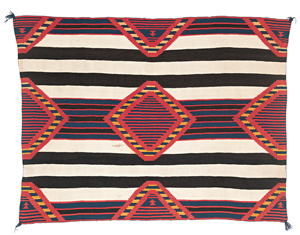 When the transcontinental train reached the territory of New Mexico in 1879, a "culture rush" began, and European-American artists and anthropologists hurried to the region to collect artworks and document native lifestyles before everything was changed past the influx of outsiders. The drawings, photographs and paintings that artists made at this time were often used to advertise the exotic Southwestern mural, and the native people who lived here.
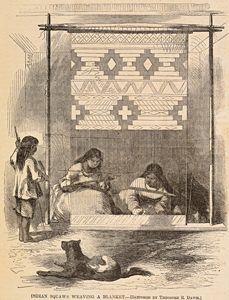 The offset images of Native American cultures in New Mexico were made by artists, writers and photographers who were paid by journals such as Harper'due south Weekly and Scribners. Illustrated manufactures near the Zuni tribe by Frank Hamilton Cushing and the Hispanic Penitente Brothers by Charles Fletcher Lummis are examples of popular articles from this time. Lummis went on to write many more than manufactures nearly the peoples of the Southwest, and he helped create a mystique most the picturesque Southwestern cultures and state.
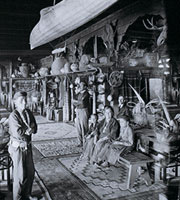 Photographers capitalized on this mystique and made postcards and calendars of Native Americans that created stereotypical images of the people who lived here. In 1902, the Fred Harvey Visitor built the Alvarado Hotel at the railroad station in Albuquerque. Role of the hotel was designated "The Indian Building" as a place where Native American artists sold their wares to tourists. This enterprise was successful, and the artists began to alter their styles depending on what sold. Consequently the artwork became less accurate and more commercial. In time, prominent artists and anthropologists would try to fight the commercialization of indigenous arts, and influence the quality of work that was created.
Statehood and a New Museum

Edgar L. Hewett created thefirst art museum in New Mexico in 1917. Hewett was an anthropologist, teacher and administrator who played a pivotal function in turning Santa Fe into a center for art and anthropological enquiry. After New Mexico became a state in 1912, Hewett created an economical plan based on developing cultural institutions and promoting the unique, indigenous qualities of Southwestern arts. After holding art exhibitions in the hi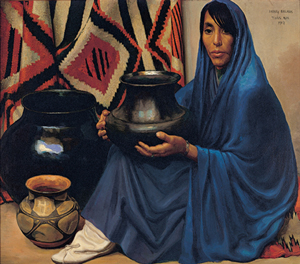 storic Palace of the Governors, Hewett'southward Pueblo Spanish revival style art museum opened in 1917. As director, Hewett was committed to exhibiting work that mixed anthropology with fine art, such equally Henry Balink's painting Pueblo Pottery. Hewett was also committed to an "open door approach", a policy promoted past the artist Robert Henri, which allowed whatever artist working in New Mexico to exhibit at the museum. This was a radical approach created in opposition to the exclusive academies that recognized merely European academic art.
 Hewett was also the director of the School for American Inquiry, and every bit an anthropologist he was very involved with Native American artists . He created the "Santa Iron Program" initially to encourage potters from San Idelfonso to improve their wares. He lucked out past meeting Maria Martinez and her husband Julian, who became masters of their medium and invented the elegant, matte black and polished black pottery that became earth renown. Hewett and his partner Kenneth Chapman worked with other Pueblo potters and encouraged the revival of ancient designs that were found on excavated pottery and petroglyphs throughout the Southwest.
San Idelfonso day schoolhouse teachers were influenced past the Santa Atomic number 26 program and began a controversial project encouraging Native American students to depict pictures course their own experiences. At this time the Dawes Human action supported the absorption of native students into the mainstream guild, and did not let federal Indian School students to acknowledge their own traditions and lifestyles, or to speak their native languages. Students like Alfred Montoya continued the practice regardless, and pueblo easel painting was incorporated into the Santa Fe Program. In later years, Hewett would showroom Pueblo easel paintings at the museum, and the artwork was highly appreciated by the local art community.
Modernism in New Mexico
In the beginning of the 20th century, at that place was a growing interest in the Southwest among European and American artists, and many came to visit, tour and work in New Mexico. Santa Fe and Taos became the most popular artist communities and the centers of the fine art scene. Later statehood in 1912, a moving ridge of academically-trained realist painters came who were attracted to the land, the lite and the native cultures. They painted images of the native peoples, their homes and the surrounding landscape.
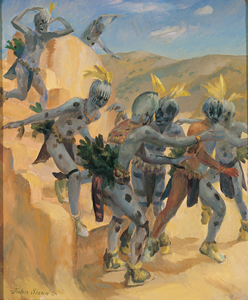 The 1913 Armory Evidence, in Chicago and New York, introduced the public to the most radical European and American art, and artists began to align themselves either with the new, the "modernists," or the old, "the academic realists." Modernist fine art expressed a more personal and emotional response to the world, rather than a replication, or mirror, of reality. In New Mexico, modernists were drawn to Santa Fe, where the Open Door policy of the Museum of Fine Arts created a identify for progressive and modern artists to show their work. Well-known artists Robert Henri and his friend John Sloan were frequent visitors from the East Coast who drew other artists to Santa Atomic number 26. European-trained academic painters and illustrators mostly congregated in Taos. After WWI these communities broke into distinct societies that sometimes overlapped and sometimes opposed each other. As time went by, art from both groups became more than modern and abstract.
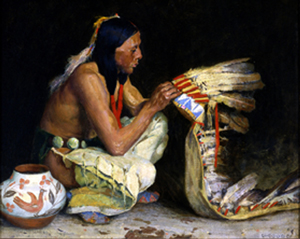 Academic painters based in Taos created pictures of Hispanic and Native American people engaged in everyday activities and religious rituals. These romantic and impressionistic pictures became some of the best-known art from New Mexico. Their images were both ethnographic studies and nostalgic portrayals of an almost bygone era. The Taos painters were sectional about their membership, and at one point, had members deported if they were not U.S. citizens. Irving Couse, Joseph Henry Sharp and Victor Higgins were influential members of this group.
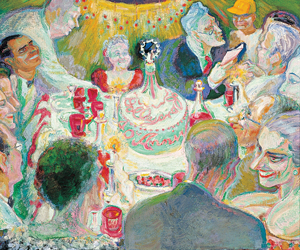 In Santa Fe, five young artists formed Los Cinco Pintores on the idea of bringing art directly to the people . Volition Shuster and Jozef Bakos were influential members of this group. The Santa Fe artists were somewhat notorious for wild parties and drinking in the fourth dimension of prohibition. The social conservatism of the political leadership in Santa Fe did non approve of their life style, or their progressive political views.
Another group known as the"New Mexico artists" attracted more than modernist painters. The coalition did non last long, but members such every bit Andrew Dasburg, Gustave Baumann, and Randall Davey accept had a long and lasting impact on the arts in New Mexico.
.jpg "Tapia - Viva la Fiesta (Zozobra)") Artists in these different groups also worked together. In 1925, Will Shuster and Gustave Baumann built a human-sized marionette in their lawn and named him "Zozobra", or Old man Gloom, and burned information technology during the Santa Fe Fiesta. Their objective was to fire away gloom, and to express their disapproval of the commercialized tourism that was taking over the authentic Santa Fe that they loved. The burning of Zozobra became a tradition and the nearly notorious event of the annual Santa Fe Fiesta.
Artists in these different groups also worked together. In 1925, Will Shuster and Gustave Baumann built a human-sized marionette in their lawn and named him "Zozobra", or Old man Gloom, and burned information technology during the Santa Fe Fiesta. Their objective was to fire away gloom, and to express their disapproval of the commercialized tourism that was taking over the authentic Santa Fe that they loved. The burning of Zozobra became a tradition and the nearly notorious event of the annual Santa Fe Fiesta.
Modernism's 2nd Moving ridge
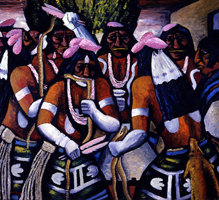 Hewett was more interested in ethnic imagery than brainchild and modernism. Even so, he did stay truthful to his policy of allowing any mode of art to hang at the museum by scheduling regular exhibitions of local artists working with abstraction. Raymond Jonson was in charge of these exhibits, and he took the opportunity to present work reverse to the predictable Southwestern ethnographic genre. Jonson and his young man abstractionist Emil Bisttram spearheaded a group of painters known equally the Transcendental Painting group. Their mission was to create non-objective work that did not refer to the natural world.
In Taos, a new group of afoot modernist artists formed around the writer Mabel Contrivance. Dodge had come from New York in 1917, originally with her painter husband whom she quickly divorced after she arrived. She married Tony Luhan from Taos Pueblo before long thereafter . Mabel had been the centre of a radical salon of artists, writers, intellectuals, socialists and activists in New York, and she invited her friends to visit her in New Mexico.
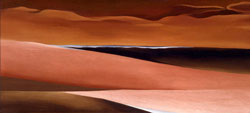 I of the get-go artists to visit Contrivance was Marsden Hartley, who was searching for a uniquely American approach to painting. After she would exist visited by Georgia O'Keeffe, John Marin, Ansel Adams, Edward Weston, Paul Strand and Rebecca Salsbury James, all prominent painters and photographers who were creatively inspired past their New Mexico visits and experiences. This group of artists were generally associated through the gallery that Alfred Stieglitz, O'Keeffe's husband, ran in New York City.
The Depression and the WPA
In 1929 the stock market crashed and the United States entered the great Depression. The tourism market in New Mexico crashed as well, and a period of prosperity for artists concluded. Educational and vocational programs were developed to promote artistic and economic development in the state.
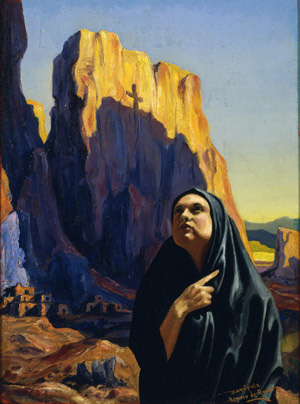 The Spanish Colonial Arts Society and the Colonial Hispanic Crafts Schoolhouse, in Galisteo were both formed in 1929 with the goal of encouraging and promoting traditional Hispanic arts. Traditional arts such every bit weaving, piece of furniture making, tinwork, colcha embroidery and wood carving were taught and promoted. Taos and the smaller villages of Northern New United mexican states were the centers for these activities, and both traditional and modern artists, philanthropists, intellectuals, and writers were involved in promoting involvement in Hispanic arts. Romero de Romero became the best known Hispanic painter from New Mexico during this time.
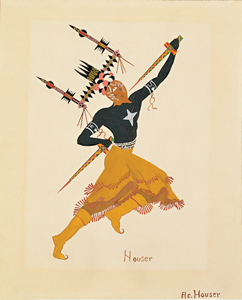 In 1932, Dorothy Dunn created the The Studio Program at the Santa Fe Indian School. Dunn was an art educator who felt that art instruction helped her Native American students master English and achieve bookish success. She taught her students a painting style based on ledger drawings, Kiva murals and first generation Pueblo easel painters. She encouraged students to draw their cultural traditions and lifeways by using flat outlined forms, without 3-D perspective or modeling. Though the aesthetics were narrowly defined, Dunn'due south students included the likes of Allan Houser and Pablita Velarde. The Studio program was a success and the new style of painting became a powerful forcefulness in New Mexican art. Dunn was succeeded by one of her students Geronima Cruz, and the program was continued until it was replaced past the Plant of American Indian Arts in 1962.
Federal Arts Projects
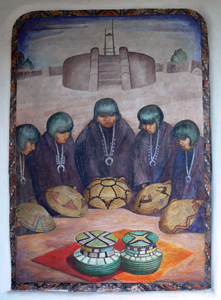 The PWAP (Public Works Arts Project) and the WPA (Works Progress Administration) were created during this fourth dimension to support unemployed artists throughout the country. In New United mexican states,160 artists created public art in 29 New Mexican communities . Volition Shuster created 4 big murals to honour Pueblo Indians at the Museum of Fine Arts, through the brusque-lived PWAP. The WPA supported a wider range of projects in public buildings and supported artists and craftsmen making prints, paintings and photographs, too every bit traditional Hispanic and Native American artworks.
FSA, or Farms Security Administration photo project
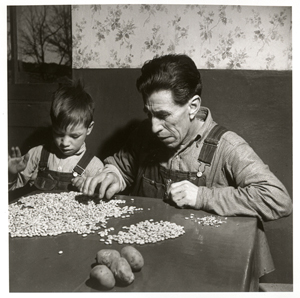 The FSA, or Subcontract Security Administration, hired photographers to document rural American lives during the Low. John Collier Jr. and Russell Lee photographed in farming and ranching communities, small villages and along the highways crossing the land. Their documentary piece of work has inspired many photographers who focus on the vernacular- on the everyday life of distinct American cultures and communities.
The Post-War Period
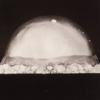
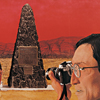
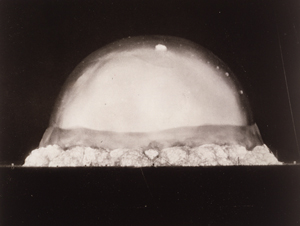 The romantic images of southwestern life seemed irrelevant after WWll. Los Alamos, NM was the home of the Manhattan project during the war years, and the Trinity Site almost Alamogordo, NM was the site of the get-go atomic bomb explosion. Many New Mexicans had fought and died in the state of war, and the state became more continued to the residue of the state and globe.
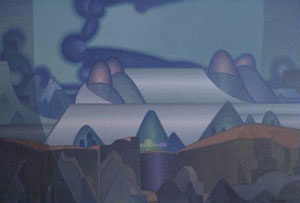 The arrival of the Diminutive age concluded New Mexico's cultural and technological isolation. The postwar boom increased industry, transportation, tourism, and the population. Albuquerque became the population center, and the arts community at the end of the 1940s blossomed in that location as well. The University of New Mexico became the heart of a thriving community of modernist artists.
Raymond Jonson moved to Albuquerque to teach at the University and opened the Jonson gallery, the simply gallery in New United mexican states devoted to abstruse and non-objective art. Jonson attracted a broad range of students to the academy'south Fine Arts 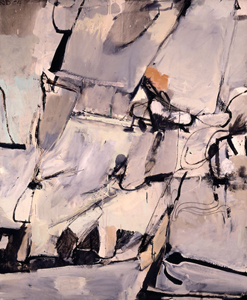 program, including returning veteran Richard Diebenkorn, from the San Francisco Bay area, and native son Joe H. Herrera. Though artists connected to congregate in the enclaves of Taos and Santa Fe, Albuquerque became the center for younger, more progressive artists.
In the Cold War era of Sputnik and the artillery race, science and technology became ascendant forces in the civilization. New Mexico became well-known for its scientific laboratories in Los Alamos and Sandia and the tiptop scientists who migrated to the land. Artists working with abstraction embraced two opposing formalist strategies in response to the times and trends: rational/geometric styles and expressive/ intuitive styles.
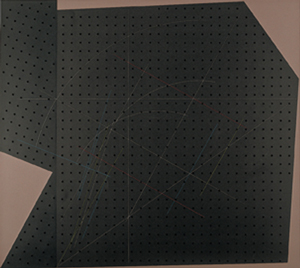
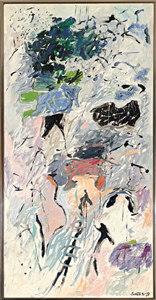
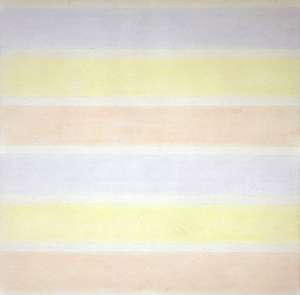
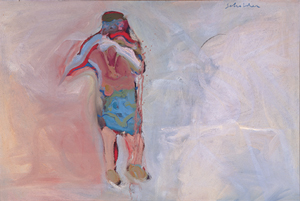
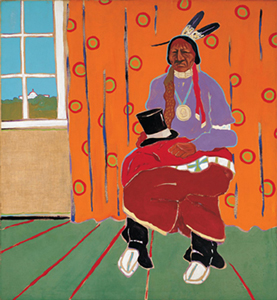
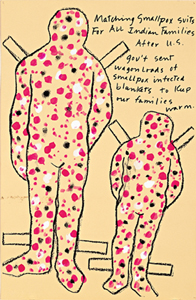
Native American art as well began to change radically during the Common cold War era. In 1962, the Constitute of American Indian Arts replaced the Studio at the Indian Schoolhouse. The school hired new kinesthesia who were engaged in contemporary bug and styles. Fritz Scholder became an important instructor there, and he energized a rebellion confronting the prevailing formalist styles of the day. Scholder combined Native American stereotypes with abstruse expressionist brushstrokes. He influenced many immature Native American artists including T. C. Cannon, who attacked Native American stereotypes and transformed them into political commentary. Subsequent movements in Native American arts became more political. Bob Haozous' Apache Skull, and Jaune Quick-To-See Smith'south Matching Smallpox Suits... accept articulate political messages most tragic events in Native American history.
Comtemporary Art and Pluralism
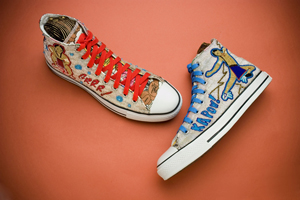 American art since the 1960s has been defined past many different movements and styles. In New Mexico, the 1960'southward Counter Culture, which attracted rebellious youth, political activists and back-to-the-globe hippies, encouraged the rejection of mainstream values and authorization. Artists in the region moved away course modernism and began to develop multiple forms of artistic expression. Pop art, minimalist art, Conceptual art, State art, political art, and feminist art, were movements that influenced New Mexican fine art during the mail-modern age. Photographers continued to migrate to the state, to document the land and culture and to experiment with new processes and means of picturing the world.
New Mexican artists investigated the atomic legacy in New United mexican states's history, and fabricated artwork that challenged and informed our understanding of celebrated events. Multiculturalism is a defining characteristic of New Mexican fine art and Native American and Hispanic artists go on to affirm their ain culture and question the ascendant Anglo culture through provocative artworks.
Today, New Mexico is nonetheless attracts artists, and Santa Fe is amid the largest fine art makets in the nation. Museums, art centers, galleries, fine art markets and events too attract many tourists who come see the diversity of art and civilisation thriving in the country. New Mexico continues to be a place where the arts are highly valued, and where artists play a vital office in the state'due south economic system and culture.
 |  |  |  |
 |  |  |  |
 |  |  |  |
Ancestral Pueblo Architecture
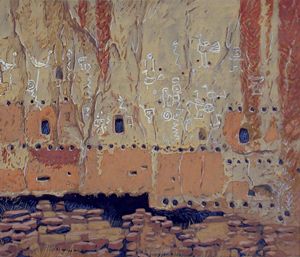 The Ancestral Pueblo people of the 4 Corners area created the first permanent shelters in New Mexico. Their history is divided into two distinct periods, the Basketmaker and the Pueblo. The primeval Basketmaker shelters were built with rock and fabricated apply of coulee overhangs and caves. Shelters evolved into pithouses, cloak-and-dagger dwellings with earth and timber roofs. Erstwhile after the yr A.D. 700, rooms were built above ground; this is considered to be the Pueblo I period. The above ground shelters were made of stone and mud, and pithouses were all the same present in groups of buildings.In the Pueblo II period shelters included multi-storied houses constructed from rock masonry and subterranean formalism kivas. Past the catamenia known equally Pueblo III, the Ancestral Pueblo people had evolved into extraordinary architects, masons and customs planners.
 Chaco Canyon is a famous Pueblo Three site in the 4 corners area and Pueblo Bonito, a "great house" in Chaco, is a fine architectural example of this menstruum. Of import characteristics of Pueblo Bonito include a D-shape plan with rectilinear buildings facing south for warmth, a large central plaza, and approximately 35 small kivas and 2 great kivas. The Chacoans were proficient masons, and they used local sandstone, which they shaped into bricks and laid carefully in horizontal strata. The ruins that be today are a attestation to how well they were built.
Archeologists believe that Chaco Canyon was an important spiritual centre for the Ancestral Pueblo people, based on the great number of kivas, and the many spiritual objects found in the ruins. There is also a belief that Chaco buildings were carefully aligned in order to observe lunar and solar cycles. Periods of drought, and perhaps other strife, acquired the inhabitants of Chaco Canyon to get out past the 14th century.
After they left their settlements in the 1300s, the Pueblo people made their way to the Rio Grande and its tributaries, and to more mountainous settlements in western New Mexico. Pueblo Four architecture was made from "puddled adobe" (mud laid in horizontal layers to build up walls), stone and sod blocks. Multi-storied residences were geometrically bundled around big plazas that included formalism kivas. Doors and windows were minimized, and ladders were used to access upper level buildings. They were situated to make use of water and to provide protection from marauders.
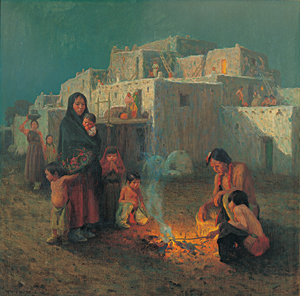 Taos Pueblo was first settled during this period and information technology has been continuously occupied ever since. Over the centuries the pueblo grew into a cute organisation of stacked and clustered blocks of buildings that have inspired architects, besides as painters and photographers, throughout recorded history.
Adobe building changed later Spanish contact, kickoff in 1593. Pueblo Indians adopted the Spanish technique of forming mud into lord's day stale adobe bricks. In the Pueblo V period, which began in the 1700s afterward the Spanish reconquest and continues to the present day , Spanish and Pueblo cultures shared and adjusted construction techniques and design.
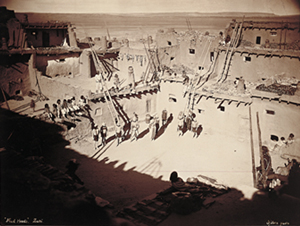 Zuni Pueblo is considered a Pueblo 5 building. The original, minor customs built of stone grew organically into a large multi-storied pueblo built with adobe bricks. Fireplaces, chimneys, horno ovens, parapets, and terraces were some of the architectural developments that occurred during the early on Pueblo Five menses.
Spanish Colonial Architecture
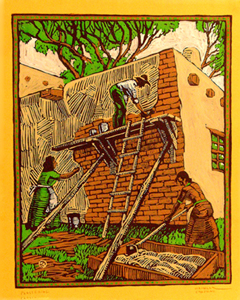 While New United mexican states was under Spanish rule, architectural developments occurred slowly. Spanish settlers were cutting off from trade with their beau North Americans. Supplies, as well as technology and ideas, had to come up from far-away Kingdom of spain. During these years of isolation, settlers lived a subsistence lifestyle and had little money or energy for developing architectural styles or engineering science. Adobe homes were simple and made from bones local materials. Details included flat roofs, earthen floors sealed with animal blood, mud plaster, wooden bars on windows, vigas and latillas for the ceiling. Glass, nails, and hardware were not available. Communities were often arranged around a plaza for defensive purposes.
Kingdom of spain focused most of its effort and money on missionary activities. The mission churches were the most significant compages during this flow, and they take been painted and photographed by numerous artists over the years. Churches were built inside Castilian communities in the northern mountains like at Rancho de Taos, Trampas and Chimayo, and in all of the Pueblos. The friars were in accuse of Pueblo church design and engineering, and the Pueblo people supplied the hard labor. Though the history of the Pueblo mission churches is fraught with controversy and tragedy, the buildings themselves are known for their simple beauty, and they have provided inspiration for of import developments in New United mexican states architecture.
Territorial Architecture
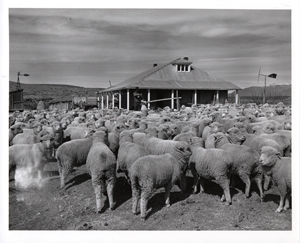 With Mexican independence in 1821, New Mexico's flow of isolation ended. Trade on the Santa Fe Trail brought new people, cultures and materials. Drinking glass, nails, hardware and tools were finally available.
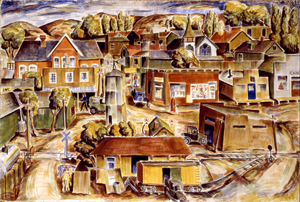 In 1848, New Mexico became an official territory of the United States. American visitors who arrived in Santa Iron via the Santa Fe Trail did not always appreciate the native architecture. Some fifty-fifty said Santa Fe looked like a prairie dog boondocks! Americans brought in milled posts and trim to make the buildings wait more than European, and built Greek Revival style buildings with white columns and classical proportions. U.S. military forts and government buildings adopted this style, now known as "Territorial." Churches were also influenced by European design, and Bishop Lamy, who came from France, built Santa Atomic number 26's St. Francis cathedral in the Romanesque Revival way.
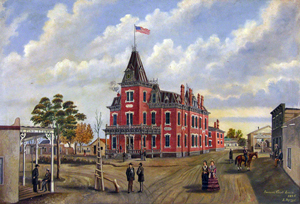 In 1880, the railroad began to influence the architectural styles in new settlements. Towns built forth the railroad like Deming, Albuquerque and Las Vegas resembled small Midwestern towns with Victorian houses, pitched metal covering, and front porches. Towns non along the railroad, such as Santa Fe and Taos, retained more than of their regional character.
Pueblo Spanish Revival Compages
Afterward statehood, in 1912, New Mexico began to abound and change more quickly. Politicians, businessmen, artists and archeologists were involved in making decisions about how New United mexican states should abound. Tourism was the central to economic development, and the "Santa Fe Plan" was created to promote and maintain a characteristic regional style based on aboriginal pueblo architecture. The model for this compages was the mission churches of Acoma and Isleta, and the sculpted adobe masses of Taos Pueblo. The New United mexican states Museum of Fine art and the La Fonda Hotel in Santa Atomic number 26, both built past the architectural business firm of Rapp and Rapp, first set the example for this type of building. Spanish colonial details such equally carved and painted vigas, herringbone patterned latillas, and hand-carved furniture were also incorporated in these buildings. This became known as "Pueblo Castilian Revival" or "Santa Iron Style."
The Fred Harvey Company congenital hotels and train stations with the objective of luring tourists to ride the railroad. The railroad financed the Alvarado Hotel in Albuquerque and the La Fonda Hotel in Santa Fe. The building designs were based on the Pueblo Spanish way, and Mary Colter, the interior designer, incorporated Native American designs, symbols, weavings and traditional artworks into the private rooms and public spaces.
The showtime New Mexican builder to invest in and develop the Pueblo Spanish Revival mode was John Gaw Meem. Meem was trained every bit an engineer and came to Santa Iron to receive treatment for tuberculosis. While recovering, he met interesting intellectuals and artists including Carlos Vierra, who photographed and painted all the mission churches in the state. Both Vierra and Meem became cardinal players in an organization dedicated to preserving New Mexico's mission churches and, in the procedure, became strong proponents of Santa Fe style architecture.
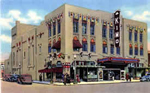 Pueblo Deco is a style related Pueblo Spanish revivalist compages. The Kimo Theater in Albuquerque is an fantabulous instance that combines elegant, simplified Art Deco lines with decoration and decoration based on Native American motifs and designs.
WPA Architectural Projects
President Franklin Delano Roosevelt created the Works Progress Administration (WPA) during the Great Depression to provide jobs for people in need. Architects and artisans benefitted from this program and built many fine buildings throughout the state during this fourth dimension. Public buildings, such as schools, courthouses, city halls and the academy, were built as well as public parks, plazas and gardens.
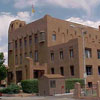 Boggling projects funded by the WPA include John Gaw Meem's buildings at the University of New Mexico and at Highlands University in Las Vegas. Many county courthouses were also built through the WPA. Trost and Trost, architects from El Paso who described their work equally "Barren Land Architecture," built the impressive McKinley County
 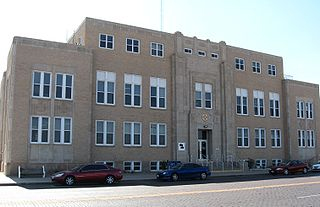 courthouse. Their piece of work was inspired by Meem, as well every bit by Chicago architect Louis Sullivan, who coined the famous phrase "grade follows function." Other courthouses, such as the Curry Canton Courthouse, were inspired past the linear simplicity and decorative ornament of art deco, or "PWA Moderne."
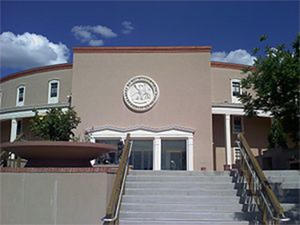 The architect W.C. Kruger leaned more than towards the Territorial way in his WPA buildings. Territorial Revival combined the local (flat roofs, earth colored stucco) with the classical (symmetrical buildings with white pedimented lintels and porticos and brick decoration) in buildings such as the San Miguel County Courthouse in Las Vegas. The culmination of Kruger's career came later with Territorial Revival State Capital edifice, the "Roundhouse," in Santa Fe.
Post-War Modernist Architecture
 The post-war menses and population growth brought influences in from new directions. Modernist buildings based on the "International Fashion," emphasized angles and precise wall planes, symmetrical balance, and minimal ornamentation. Simplified rectangles, floor-to-ceiling glass, and an honest use of materials, revealed rather than concealed, were too characteristics of this style. The Simms edifice in Albuquerque was built in the modernist "International Style," and it was the showtime skyscraper built in New Mexico.
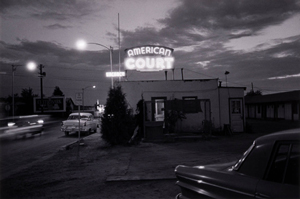 The machine boom brought the need for an architecture of motels, gas stations and diners by the roadside. This populist architecture incorporated mod buildings, desert decoration, neon signs and advertisements adult to attract motorist from a distance as they drove across the state. Photographers and artists have been inspired by the colorful roadside attractions and buildings that can withal be seen when driving on highways across New United mexican states such equally Route 66.
Contemporary Architecture
John Gaw Meem'southward influence and Santa Atomic number 26 Fashion is still a function of contemporary architecture in New Mexico especially in the northern part of the country. However, many different styles of architecture exist in New Mexico today. Postmodernism has meant more liberty for architects to limited themselves and to be influenced by a broad variety of styles.
The land, space, heaven, light and the history of New Mexico go on to inspire contemporary architects. It is a identify for edifice in experimental means with alternative earth materials such as harbinger bale, fired adobes and rammed globe. In addition, the abundance of solar free energy in the Southwest, has encouraged architects to create free energy-efficient buildings that rely on the sun for estrus and electricity. New Mexico architecture is still influenced by its past, merely information technology also looks toward the future with innovative and environmentally conscious, "dark-green" materials and technology.
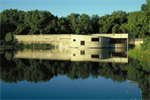 Antoine Predock is an internationally renowned architect based in Albuquerque. His La Luz residence, on the Westward Mesa, and Rio Grande Nature Center, in the Bosque, are elegant buildings that blend with and focus on the surrounding landscape. He believes in a "portable regionalism" that he discovered through living and working in New Mexico and now takes with him around the world. For more information> http://www.predock.com/
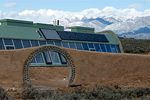 Michael Reynolds came to Taos, New Mexico, in the 1970s and began to build his "Earthships" from earth and recycled materials, including tires, bottles and aluminum cans. His buildings are designed to be off-the-filigree and self-sufficient with solar power, thermal mass, and h2o harvesting. His edifice forms are organic and fluid, busy with colored glass and aluminum. For more information> http://www.earthship.com/
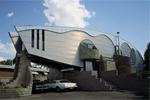 Bart Prince is an Albuquerque architect who builds residences through an organic procedure, synthesizing the customer'south needs, the site, the materials and his ain ideas. Prince's buildings are eccentric, eclectic, creative and fun. For more information> http://www.bartprince.com/
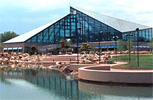 Santa Fe builder Ed Mazria strongly believes it is important to lower the carbon footprint of architecture. His glass building at the Biopark, in Albuquerque, is an enclosed institute ecosystem that consumes very niggling energy to function, yet creates a year-circular sustaining climate. His Architecture 2030 initiative focuses on making all compages carbon neutral by the yr 2030. For more information> http://world wide web.mazria.com/
shanahanhiphell1958.blogspot.com
Source: https://online.nmartmuseum.org/nmhistory/art-architecture/history-art-and-architecture.html
0 Response to "Southwest International Ethnic Culture and Art Center Art Studio"
Postar um comentário